
How Hydrophobic Coatings Change the Way Corrosion Starts
Most chemical- and corrosion-resistant coatings fail the same way. Water sits, then evaporates, but the Salts stay. The coating film is still on the part, but the electrolyte is now living on top of it.
Hydrophobicity is how you interrupt that sequence.
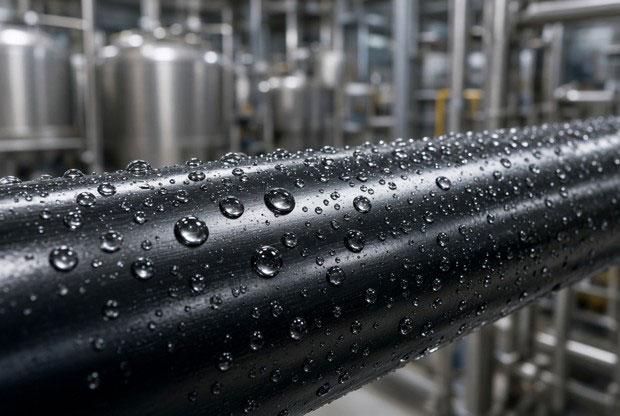
If water cannot wet the surface, it cannot easily feed the corrosion cell.
The coating is not the whole story
At Extreme Coating Solutions, we apply functional coatings. That means the film has a job: release, barrier, heat management, chemical resistance—or some combination.
A good barrier chemistry still needs help if process water, wash chemicals, or coastal salt can dwell on the surface. That is why we often put a hydrophobic topcoat over an already-capable system. The base coat handles adhesion and chemistry. The hydrophobic layer cuts wet time and keeps contaminants from hanging on.
Four things hydrophobicity actually does
- Breaks the water film. No continuous electrolyte, fewer electrochemical cells on steel, aluminum, and brass.
- Reduces deposit dwell. Salts, splash chemicals, and process residue have less time to sit and concentrate.
- Self-cleans under flow. Droplets roll and take dirt with them. Less wash frequency. Fewer defects under trapped soil.
- Tightens the barrier. Highly crosslinked siloxane and silazane networks resist water and ion permeation. Thickness still matters. Hydrophobicity makes that thickness work harder.
It is not a substitute for the rest of the system
Contact angle does not fix poor adhesion. It does not forgive the wrong resin in strong acid. It does not replace film build.
Before we add a hydrophobic layer, we still ask:
- What is the substrate?
- Splash, vapor, or immersion—and at what temperature?
- Which chemicals, at what concentration and pH?
- Does the part flex, abrade, or thermally cycle?
- Is PFAS-free, food-contact, or a specific VOC limit required?
Then we validate. Salt fog or CASS. Chemical spot or immersion. Adhesion. Abrasion. Flexibility. A single coupon test is not a specification.
In coatings, a coupon is a small, flat sample panel (often a few inches square) made from the same substrate as the real part, such as steel, aluminum, or brass. The panel is prepped and coated exactly the way the production part would be, then put through a test in place of the actual part.
Where plants actually use this
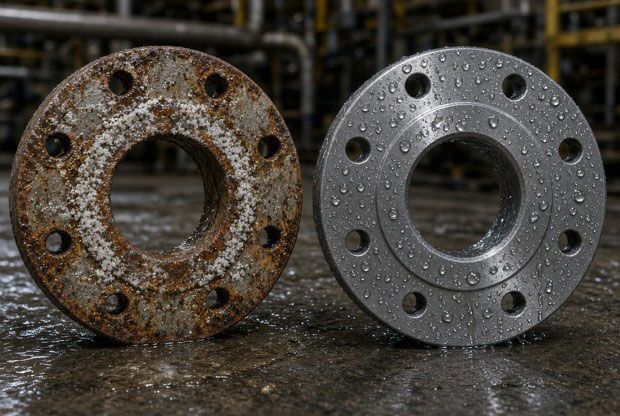
Chemical processing. Acid and brine films on piping, flanges, and tank exteriors. Hydrophobic topcoats keep splash from sitting at welds and fasteners.
Food processing. Washdown chemicals and product residue on frames, hoppers, and rollers. Low-energy films shed water and soil—when the chemistry matches the contact class.
Tooling and rollers. Mold water jackets pit from chlorides and MIC. Tool faces pick up flash. One hydrophobic system can cut both corrosion and buildup.
Marine and coastal. Salt aerosol never dries. Reducing chloride dwell extends the time between wash-and-touch-up cycles.
Fleet and polished aluminum. Road salt and high-pH washes stain and pit wheels, tankers, and trailers. A clear hydrophobic film protects reflectivity without a heavy pigmented coat.
Cooling water and wastewater. Biofilm plus chlorides is a corrosion accelerator. Hydrophobic walls are harder for microbes and deposits to colonize.
Oil, gas, and energy. Produced-water splash and coastal skids. Under-deposit corrosion is where coatings usually fail first.
Aerospace and composite tools. Moisture in cooling passages and on mold faces drives pitting and vacuum leaks. Thin hydrophobic sealers protect the metal and keep release surfaces cleaner.
Same environment. Different surface energy.
The question we ask customers
We don’t ask, “Is the coating hydrophobic?”
We ask this: “Does hydrophobicity, on this chemistry, on this part, cut wet time and permeation enough to move the failure date?”
That is a measured answer. We run the tests in-house so we are not guessing from a data sheet.
If a part is staining, pitting, or picking up residue between wash cycles, send the substrate, the chemical list, and the temperature. We will tell you whether a hydrophobic upgrade is worth the film build—or whether adhesion and barrier chemistry need to be fixed first.
Jim Stuelke is CEO of Extreme Coating Solutions in Kansas City, an applicator of functional coatings since 1959.
info@extremecoatingsolutions.com • 816.381.9901 • www.extremecoatingsolutions.com

